Gray light, five people on the sidewalk, and no light in the plate
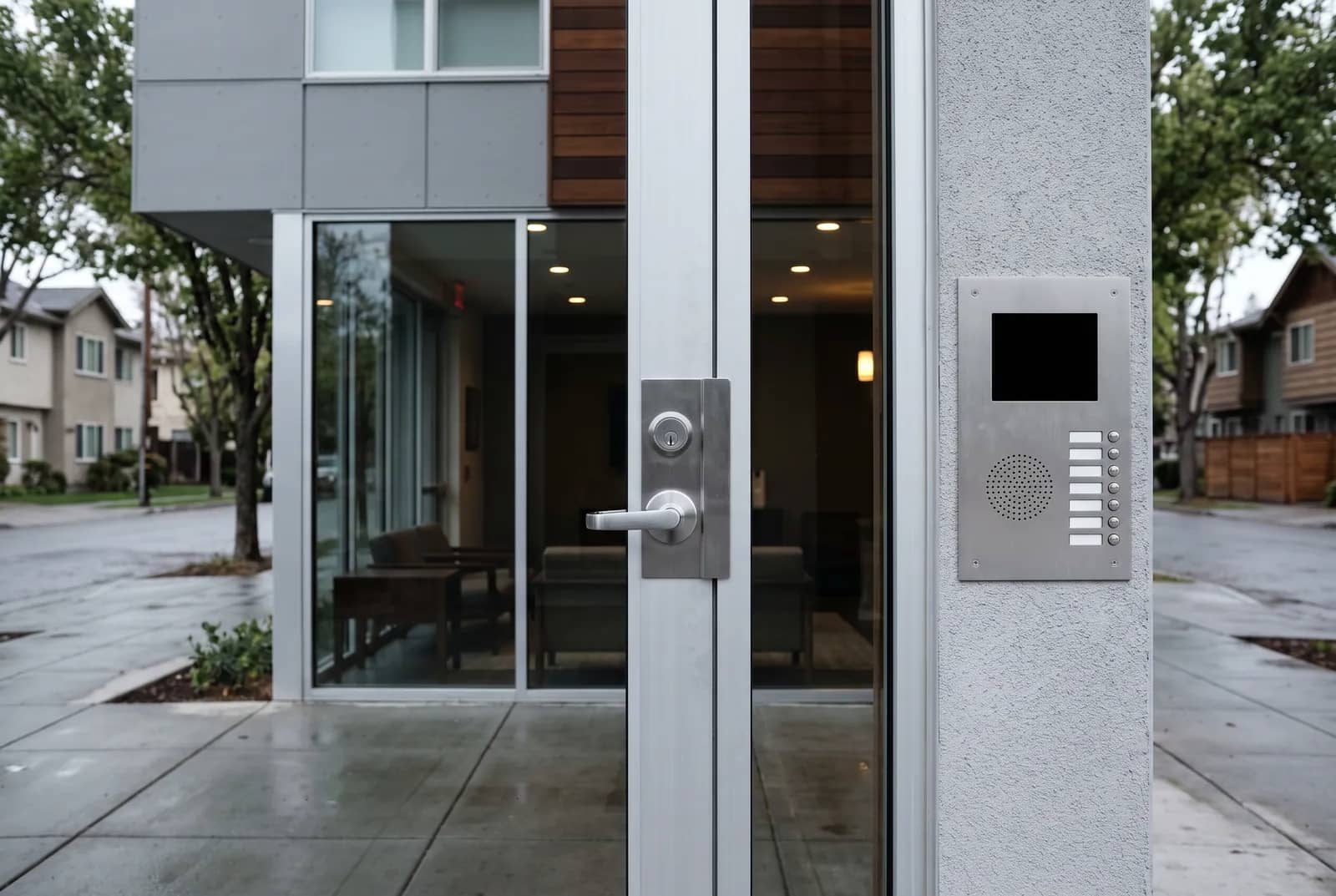
It is a little after six. The lobby door is glass in an aluminum frame and it is shut. On the wall beside it, at about the height of a coat pocket, sits the plate everyone in the building touches twice a day: a brushed rectangle, a speaker grille, a column of call buttons. There is normally a small light in the reader window, red or amber, and nobody has ever looked at it on purpose. This morning there is nothing in it at all.
Five people are on the sidewalk with bags and coffee. Two of them have already held a fob against the plate three times, closer each time, the way you shake a remote that has stopped working. A third is pressing the call button for a unit that has no reason to answer at six in the morning. The fobs are all fine. Every one of them would work at a door with power behind it.
That gap between a working credential and a door that will not move is the ordinary shape of an access failure in this city. Nothing has been broken into, nothing has been damaged, and no part of the visible hardware looks any different than it did yesterday.
The reader is the smallest part of a chain
What people call the reader is one link in a run of four or five. The plate reads the credential and passes a number down a wire. A controller in a closet or an electrical room decides whether that number is on today's list. A power supply feeds both of those and also feeds the piece of hardware that actually holds the door: an electric strike set into the frame, or a magnet at the top of the leaf. A pair of small devices watch whether the door is shut and whether someone inside has asked to leave.
A dark plate almost never means the plate has failed. Readers are simple, sealed and cheap to run, and they light up on very little. Nothing in the window usually means nothing is arriving at it: a tripped breaker in the electrical room, a power supply whose backup battery finally aged out, a board that took a surge in the night, or a low-voltage line that a contractor pulled loose while working on something else entirely.
There is also the case where the electronics are alive and the answer is still no. A network outage can leave a controller unable to check its list, and a door set to hold locked in that condition will do exactly that. It is not a fault. Somebody chose it when the building went up, and for an outside door facing the sidewalk it is a reasonable choice.
Getting out is never the problem
Look at the same door from the inside and it is a different object. The exit side is mechanical: a lever, a push bar, a paddle. It does not ask a controller anything, it does not need power, and it will let a person out with the whole system dead and the building dark. That is how these doors are supposed to be built and it is why a dead reader is an inconvenience rather than an emergency.
It also produces the shape of the day. At half past six the door lets everyone out and no one notices. The calls start at six in the evening, when the same people come back, and they arrive in a group because the whole building meets the same door at the same hour. If a plate has been dark since dawn, the first person who reports it is usually the first person who tried to come home.
There is a metal way in, and it is closer than people think
Every one of these doors has a cylinder on it somewhere, because a building that can only be entered by a working circuit is a building nobody can service. On a glass lobby door the cylinder is usually in the lock body of the leaf itself, at handle height, or in the fixed mullion between two leaves. On a package room or a mail hall it is a small plain cylinder on the face. Under a wall panel there is often a cover plate the size of a stamp that slides aside over another one.
Find it and the next problem appears immediately: it has not been turned in years, and there may not be a cut key for it anywhere in the building. That is common enough to have its own article on this site, because a seized override cylinder is the second half of most dark-reader calls and it is the half nobody plans for.
The key that does exist usually lives in a management office that opens at nine, or on a contractor's ring, or in a kitchen drawer belonging to a resident who was handed one years ago and never used it. None of those are on the sidewalk at six in the morning.
Which call to make first
Two calls, in this order. The building first: the on-call number, the management office, the property line printed on the notice in the mail hall. The credential system belongs to the building. The list of active fobs, the controller, the wiring, the account with whoever installed it, the spare readers on a shelf somewhere in the garage: all of that sits inside a contract the residents are not party to, and the fastest route back to a working door usually starts there.
A locksmith is the second call, and covers the part that is metal. Opening the door. Freeing or replacing the override cylinder. Cutting and testing a key for it. Putting the mail hall and package room back on keys that people actually hold. Rehanging or adjusting a leaf that has drifted enough to fight its own strike.
Who orders work on a shared door is settled on the phone before a van moves, and it is a matter between the resident and the building. On the door of your own unit it is straightforward and the work starts when you say so. On the lobby door it is not, and pretending otherwise wastes an evening for everybody.
What the visit costs and how fast it gets there
Getting a resident into their own apartment is a house lockout at $138 to $252, with the $89 service call already counted inside that figure rather than added after it. Between 8pm and midnight the figure carries $52, and between midnight and 7am it carries $92. Both are said on the phone, so the number you hear before the van leaves is the number on the receipt. Ninety days on the labor.
A shared entrance on commercial hardware, opened at the building's instruction, is a business lockout at $148 to $272. If the override cylinder in a glass storefront leaf turns out to be seized or missing, that is storefront door work at $168 to $495. A plain cylinder that only needs new pins and a fresh key is $32 to $50, and the second and third on the same stop sit at the low end because the van is already there.
Drive time runs about 18 minutes on average from the base near Castro Street. The blocks where readers are thickest are the ones farthest out: Greater San Antonio is 22 minutes, North Whisman 24, North Bayshore 26. Old Mountain View is 12 and Shoreline West is 14. Saying which building and which cross street on the call is worth more than any description of the panel.
Making the next outage boring
The whole difference between a dead reader that costs a building nothing and one that costs it an evening is whether the metal path was maintained while the electronics were working. That means a cylinder that turns, a key that has been cut and tried in the door rather than only on a bench, and a person who is physically present at night holding one.
It is worth asking the building three questions in daylight, in writing, without any urgency attached. Where is the override cylinder on the lobby door. Who holds a key for it after hours. When was it last turned. Buildings that can answer all three do not generate this call. Buildings that cannot generate it about once a year, usually in the dark, usually in the rain.
Quick answers
The panel is dark and my fob does nothing. Is my fob dead?+
Almost certainly not. A fob has nothing in it to go flat, and a dark reader window means the plate is not receiving power rather than that it has stopped listening. Try the same fob at another door on the property. If that one opens, the problem is at the first door and belongs to the building.
Can you make the lobby door work again?+
The mechanical half, yes: the door gets opened, and the override cylinder is freed, rekeyed or replaced so it is usable next time. The electronics belong to the building's own system and its installer, and we do not touch someone else's controller or issue credentials for it.
What does a call at six in the morning cost?+
The overnight window runs to 7am and carries $92 on top of the figure. A house lockout is $138 to $252 with the $89 visit already inside it, so a six o'clock call lands in that band plus the overnight amount, quoted on the phone before anyone sets off.
Need it handled rather than read about?
(650) 405-1526More guides