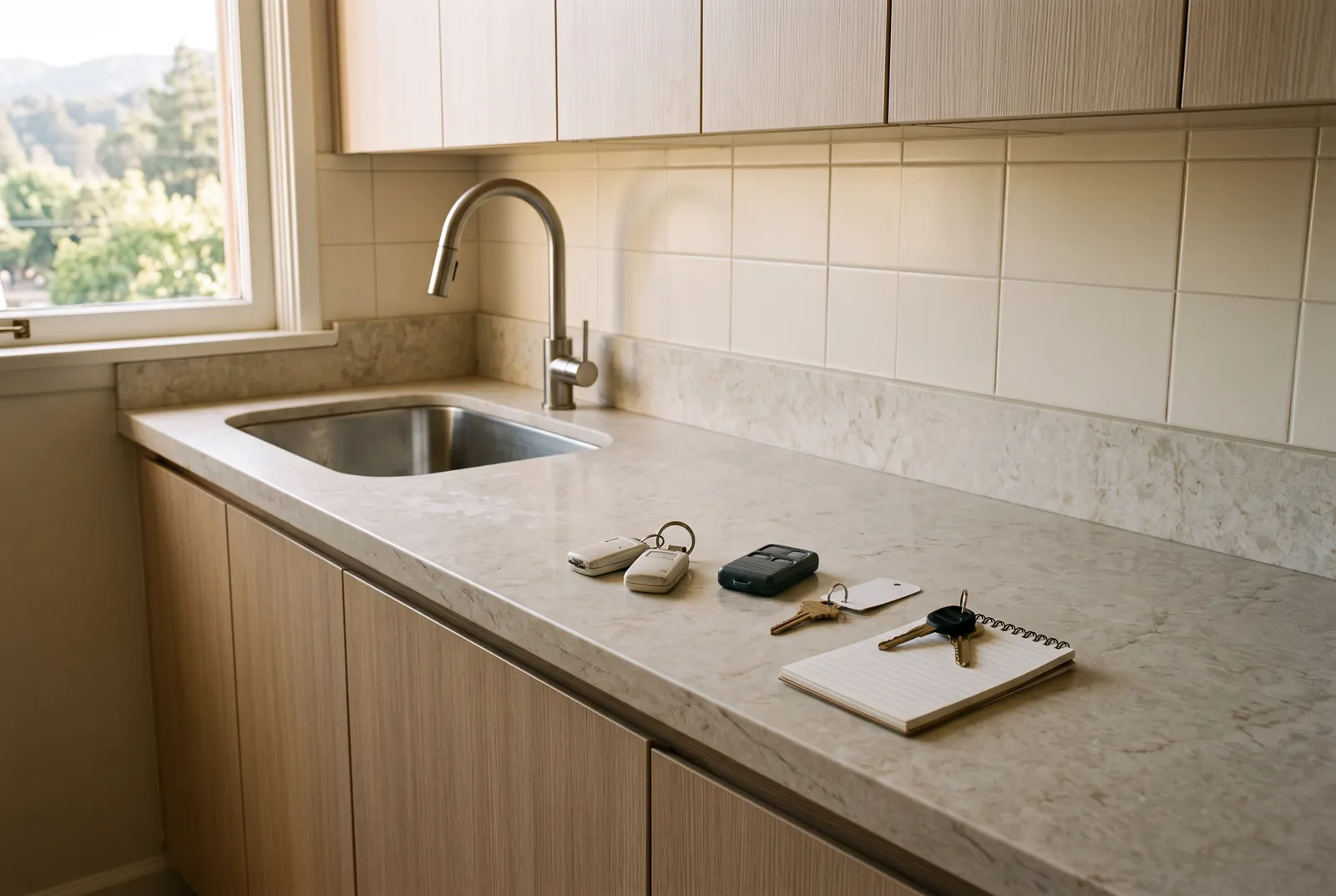
Everything that gets handed back, laid out on the counter
The kitchen counter is empty except for what has to go back. Two white fobs, both a little scuffed, on a split ring. A garage remote with a worn button. One small flat key with a paper tag looped through it, the kind that opens a mailbox. A brass door key with a plastic cap. A printed sheet from the office with boxes to check. Behind all of it, an apartment with nothing left in it and the afternoon light coming across a bare floor.
That pile is two different kinds of object, and treating it as one thing is where most move-outs go slightly wrong. The fobs and the remote are numbers. The two keys are metal. Numbers get switched off. Metal gets re-pinned. They are unrelated jobs done by unrelated people, and only one of them is a locksmith's work.
This city turns over quickly. People arrive and leave on work cycles rather than on the school year, so move-outs happen in every month and buildings run this routine constantly. Where the routine is written down it takes a day. Where it is not, it takes a month and leaves loose ends.
Two words that get used as if they meant the same thing
Revoking is what happens to a fob. Somewhere there is a list of credential numbers with a status against each. Removing the departing resident's number from that list takes seconds and can be done from a desk, and after it the fob is a piece of plastic. It is not re-cut, it is not reprogrammed, and it does not need to come back for the change to take effect. That last point surprises people and it is the useful part: an unreturned fob is not a problem in the way an unreturned key is.
Rekeying is what happens to a cylinder. The pins inside change, a new key is cut, and every key made before that afternoon stops working. It is physical, it happens at the door, and it costs $32 to $50 per cylinder. There is no list involved and no way to do it from a desk.
The two failure modes are opposite, which is why the distinction matters. An access system fails when nobody updates the list, and the fix is administrative. A cylinder fails when copies were made and nobody counted, and the fix is a van at the curb. A building that does one and not the other has half a move-out.
The part the building does, and we do not
Deactivating the old fobs, issuing new ones, setting the entry codes, and anything that touches the controller sits with the property. It is their system, on their contract, with their installer, and their records of which number belongs to which unit. We do not program building credentials, do not hold accounts on anyone else's platform, and do not offer to. That boundary is worth stating plainly because it saves a phone call.
The practical advice for a resident is short. Ask the office to confirm in writing that the previous credentials are off the list, and ask on the day you get the keys rather than a week later. Ask how many fobs are active for the unit, because the answer is sometimes three when two were handed over. And ask whether the entry code for the package room or the mail alcove is shared by the whole building or set per unit, since those are two entirely different exposures.
Who orders work on a shared door, and who pays for it, is settled on the phone before anything starts. That is between the resident and the building, and it is not something a locksmith decides on someone's doorstep.
The part that is still metal
The door of the unit itself is almost always an ordinary cylinder, exactly like a house door, and it is the one thing on the whole property that no list controls. Every key ever cut for it still works: the one the last resident kept as a spare, the one a cleaner had, the one that went to a sitter in a building three blocks away. Rekeying settles that in twenty minutes at $32 to $50, with the $89 visit counted once for the stop.
Then the small ones. A mailbox key on its paper tag. A storage cage in the garage, usually a padlock, sometimes the resident's own. A bike room. A gate latch beside the garage ramp with a plain cylinder in it that opens with metal even though the vehicle gate opens with a remote. None of those are on the access system and all of them are easy to leave behind. Two or three extra cylinders on the same visit sit at the low end of the range because the van is already there.
A note on the mailbox. If the mail comes from a cluster box at the curb, the lock in the little door is the postal service's business and their carrier's key opens the back of it, so that one is arranged through them rather than through us. If the mail lands in a hall inside the building with its own lockable cabinet doors, those are ordinary small cylinders and they are ours.
The remote in the pile
A garage remote deserves its own paragraph because it is the one credential that is often neither on a list nor on a key ring. Some buildings run the vehicle gate through the same system as the fobs, in which case it is revoked with everything else. Plenty of others use plain remotes bought in bulk, paired to a receiver, with no record of how many are in circulation.
Where that is the case, ask the property whether the receiver can be cleared and the current remotes re-paired. It is a task for whoever maintains the gate, not for a resident, and not for us. It is worth asking because a vehicle gate is the largest opening in the building and a remote that left with a car three tenancies ago is invisible to every other control the property has.
The car version of this question is different and does sit with us. Programming a remote for a vehicle is $98 to $208, and replacing a car key is $163 to $438. Those are cars, not buildings, and the two get mixed up on the phone often enough to be worth separating here.
A move-in list that takes one visit
Walk the unit and count cylinders rather than doors: the entry door, sometimes a second cylinder in the same leaf, the mailbox if it is inside the building, the storage cage, the bike room padlock if it is yours. Write the number down. Four cylinders is common and six is not unusual once the garage is included.
Then one stop. Rekeying is $32 to $50 a cylinder with the $89 call counted once for the trip, and at the end of it every key issued to the last resident is scrap. Average arrival is about 18 minutes: Greater San Antonio 22, North Whisman 24, Shoreline West 14. Between 8pm and midnight the figure carries $52 and between midnight and 7am it carries $92, both quoted on the phone. Ninety days on the labor.
One last thing, and it is free. Before the technician leaves, take the new key and lock and unlock every door from both sides while somebody is still standing there. A key that works on the bench and binds in the door has not been tested, and thirty seconds now is worth an evening later.
Quick answers
The last resident never returned one of the fobs. Is that a problem?+
For the electronic doors, no, as long as the property removes that credential from its list. A fob with its number switched off opens nothing whether it comes back or not. Ask the office to confirm the deactivation, and ask how many credentials are still active against the unit.
Do I need the apartment door rekeyed if the building changed my fobs?+
Yes, they are separate. The fob list has no connection to the pins in your door cylinder, and every metal key ever cut for that door still opens it. Rekeying is $32 to $50 per cylinder and takes about twenty minutes for a typical unit.
Can you deactivate the old fobs for me?+
No. Credentials belong to the building's own system and are managed by the property and its installer. We handle the metal side: the unit cylinder, the mail hall cabinet, the storage cage, the gate latch beside the vehicle gate, and any override cylinder that has stopped turning.
Need it handled rather than read about?
(650) 405-1526More guides