A small brass circle nobody has looked at
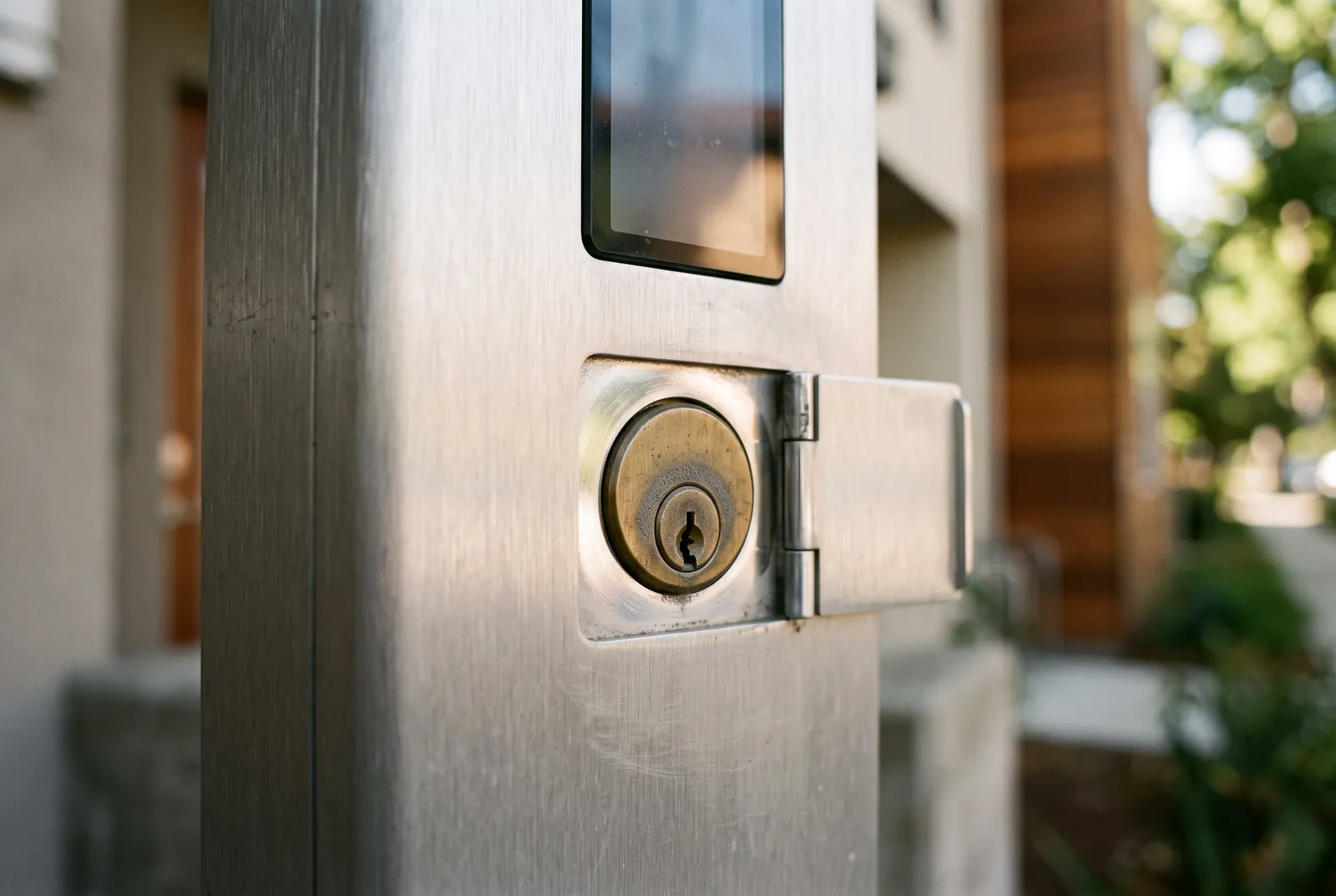
The cover plate slides sideways and there it is, at the height of a raised hand: a brass cylinder about the width of a nickel, set flush in the plate, with a keyway that has a faint gray film across it. The finish around the edge has gone dull where the plate rubbed. Nothing about it looks broken. Nothing about it looks recently touched either, and that is the whole story.
A key goes in. It goes in most of the way, stops a hair short, and then either refuses to turn at all or turns a few degrees and stops against something that feels solid rather than sprung. The instinct at that point is to push harder, and pushing harder is how a brass key ends up in two pieces with the longer half still in the door.
This cylinder is not decoration. It is the entire plan for the morning the reader has no light in it, and it is why the door can be serviced at all when the wiring behind it is dead. On a building ten or twelve years old it has usually been turned twice: once by the installer and once by whoever handed the building over.
What ten still years do to a lock
A lock is a set of small parts that only stay free by moving. Five or six spring-loaded pins ride up and down in a plug that turns inside a shell, and the clearances between them are a few thousandths of an inch. That is enough room to work and not much more, and everything that happens in ten years happens in that space.
The factory lubricant goes first. Most cylinders leave the plant with a light film on the pins, and a film that never gets disturbed dries and turns to a soft varnish that grips. Then oxidation: brass and steel sitting against each other in a door frame that is warm at noon and cold at four in the morning, with the marine air that comes in off the bay overnight, grow a fine white or green bloom on the sliding faces. Neither is dramatic. Both add drag, and drag adds up until the springs can no longer push a pin back down.
Then there is what gets in. Doorway dust is mostly grit and fiber, and it settles into a vertical keyway like sand into a jar. On outside panels, add whatever the sprinklers throw at the wall every morning. On a panel that faces west, add ten summers of afternoon sun on a metal plate that gets considerably hotter than the air around it. A cylinder in that position ages at a different rate than the identical one on a north wall twenty feet away, and buildings are always surprised by that.
The key is usually the other half of the problem
Half the override cylinders we are called to were never seized at all. They simply have no correct key anywhere on the property. The originals went into an envelope at handover, the envelope went into a filing cabinet, the filing cabinet went with a management company that changed three years ago. What is on the ring today is a copy of a copy, cut from a worn key rather than from an original, with cuts that no longer lift the pins to the right heights.
There is a second version of this. The building has a key, it is the right key, and it is for the cylinder that used to be in that door before a panel was replaced. From the outside the two look identical. From the inside they take different blanks entirely, and no amount of jiggling closes that gap.
The useful test is boring and takes ten seconds. The key should slide to the shoulder in one movement with no lifting and no wiggling, and it should turn with about the pressure it takes to turn a car ignition. Anything more than that is a warning, not a quirk, and it is telling you today what it intends to do on the morning you need it.
What not to do to a cylinder that will not turn
Do not force it. Brass keys are made to be softer than the pins so that a key fails before a lock does, which is a sensible design and a miserable evening. A key that snaps flush with the face has to be extracted before anything else can happen, and extraction on a small mortise cylinder set into a wall plate is fiddly work in an awkward position.
Do not spray a general purpose penetrating oil into it. Those products are solvents with a light oil behind them, and inside a keyway the oil stays, collects dust, and turns into a paste that works better than the original varnish did. A cylinder treated that way runs beautifully for a week and then binds worse than before.
Do not hammer the key in, and do not put a pair of pliers on the bow for leverage. Both of them turn a fifteen-minute service into a replacement. If a key will not turn with two fingers, the answer is a cylinder that comes off the door and gets opened up, not more force applied to the outside of it.
What putting one back in service actually involves
The cylinder comes out. On a wall plate that is usually a set screw and a short cam. On a glass door it means getting at the lock body in the edge of the leaf. Out on the bench it comes apart, the plug and the pins are cleaned dry, the springs are checked because a collapsed spring is a common finding in a lock this age, and everything goes back with a dry lubricant rather than an oil. Dry is the point: nothing left behind for dust to stick to.
While it is apart, it gets new pins to a fresh combination and a new key cut to match, which is a rekey at $32 to $50 per cylinder. That is worth doing whether or not anyone is worried about old keys, because it is the only way to be certain the key on the ring and the lock in the door are actually a matched pair. A second and third cylinder on the same stop sit at the low end of that range, since the van is already at the curb and the $89 visit is counted once for the trip.
Where the shell is worn through, the plug is rounded, or the cam is bent, the answer is a replacement instead: $133 to $345 for a standard cylinder and its hardware, and $168 to $495 where it is a lock in an aluminum storefront leaf, which is most lobby doors on the newer blocks. Those figures include the $89 call. Evening work between 8pm and midnight carries $52 and overnight between midnight and 7am carries $92, both named before the van moves. Ninety days on the labor.
The keys nobody wrote down
One cylinder is rarely the whole job, because the metal side of a building is scattered. There is the lobby leaf, the mullion beside it, the man gate next to the garage ramp, the package room, the mail hall, the roof access, the electrical closet, and the little cabinet holding the fire department's key box. Every one of those has a cylinder and most of them are on a different key, for the ordinary reason that they were installed by different trades in different months.
Sorting that out is a survey job rather than a price on a page, which is why master key systems and access control are quoted after a look rather than from a list. But the survey itself is short, and the outcome is a written page that says which cylinder takes which key and who holds it. Buildings that have that page do not call at six in the morning.
A two-minute habit, once a year
Pick a date. Walk the doors with the override keys in daylight, with the electronics working normally, and turn every cylinder twice in each direction with the door standing open. That is it. Two minutes per door, no tools, no cost. A cylinder that turns freely on that walk will still turn in February.
A cylinder that fights on that walk has told you in the most convenient possible circumstances. Nobody is locked out, nothing is urgent, the sun is up, and a service visit can be scheduled for a Tuesday afternoon at the ordinary daytime figure rather than at the overnight one. That difference is the entire argument for the walk, and it is not a small difference.
Quick answers
The key goes in but will not turn. Is the lock broken?+
Usually not. Dried lubricant, oxidation and doorway grit put enough drag on the pins that the springs cannot return them, and the plug stops. The cylinder comes off, gets cleaned dry, gets new springs where they have collapsed, and goes back with new pins and a fresh key at $32 to $50.
My key snapped off in the cylinder. What happens now?+
The broken half is extracted first, then the cylinder is judged on what comes out of it. If the plug is undamaged it is cleaned, rekeyed and a new key is cut at $32 to $50. If the plug or the cam was distorted by the force, it is a replacement at $133 to $345, or $168 to $495 in an aluminum storefront leaf.
Should I oil the cylinder myself?+
Not with a general purpose penetrating spray. The oil stays behind, collects dust and sets into a paste that binds harder than the original film. A dry lubricant is the right product, applied to a clean lock rather than over ten years of grit, which is why cleaning comes first and lubricant second.
Need it handled rather than read about?
(650) 405-1526More guides