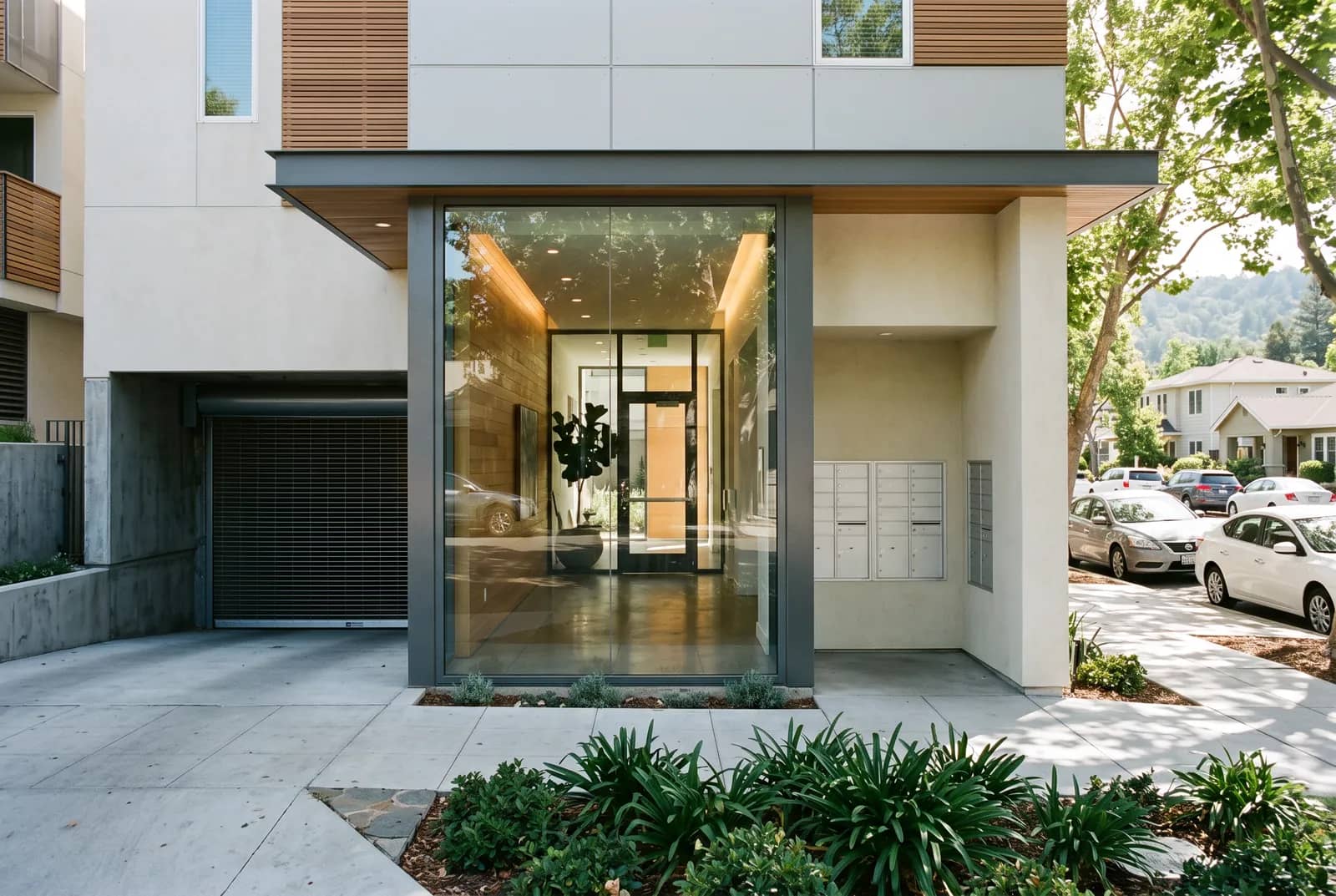
Three doors visible at once, standing on the sidewalk
Stand on the walk outside one of the newer blocks and look straight in. The first door is glass in an aluminum frame with a long vertical pull. Through it, ten feet back across a lit lobby, is a second glass door with the elevators behind it. To the left the sidewalk drops away down a concrete ramp toward a rolling gate with a strip of yellow paint across the entrance. Off to the right, set into the wall, is an alcove with two rows of small metal doors in it.
Four thresholds, and one of them you cannot see from here because it is on the fourth floor. A person coming home passes through three of them without thinking, in about forty seconds, holding a fob and a phone and a bag of groceries. Each one is a different piece of hardware with a different way of failing, and confusing them on the phone is the most common reason a call takes twice as long as it should.
Older blocks have a shorter list. In Sylvan Park or on the streets around Cuesta Park there is exactly one door between the sidewalk and the kitchen, and it takes a key. The contrast between those streets and these ramps is most of what this city is, and it is why one price list has to cover both.
Door one: the lobby leaf
This is an aluminum storefront door, the same family of hardware you would find on a shop, hung with either butt hinges down one side or a pivot at top and bottom. A closer overhead brings it back. The lock is usually not a deadbolt. It is a latch held shut against a strike in the frame, and the electronics either hold that strike or hold a magnet at the head of the leaf.
It fails in three ways. The electronics stop, which is the dark reader and which does not touch the mechanical parts at all. The closer weakens or the leaf drops, so the door no longer pulls itself fully into the strike and sits an eighth of an inch out, which lets it look shut and be open. Or the cylinder in the leaf, the one nobody turns, seizes. That last one is not noticed until the first of the other two happens.
Work on this door is storefront hardware at $168 to $495, or a business lockout at $148 to $272 where the property has asked for the door to be opened. Getting the leaf hanging right again is usually the more valuable half. A door that latches properly on its own does not need anybody's attention for years.
Door two: the vehicle gate and the small gate next to it
The gate itself is a machine rather than a lock: a rolling or swinging leaf driven by a motor, with a remote or a reader on a pedestal at the top of the ramp, a loop of wire buried in the concrete that senses a car, and a safety edge. None of that is a locksmith's work and we say so on the phone rather than at the bottom of the ramp.
The part that is ours stands three feet to the side of it. Almost every vehicle gate has a small pedestrian gate beside it, and that one has a plain cylinder in it, on a latch, in a metal frame. It is the way in and out of the garage on foot when the big gate is not moving, and on many buildings it is the single most useful cylinder on the whole property. It is also the one most likely to be stiff, because it lives outdoors and takes weather from two sides.
The other call from this ramp is the ordinary one: keys shut inside a car on P1 with the groceries on the passenger seat. That is a car lockout at $112 to $208, and the $89 visit is inside the figure. Where the key itself has failed rather than been locked in, a replacement is $163 to $438 and programming a remote is $98 to $208.
Door three: the mail alcove and the package room
These are the small locks, and they are a genuinely different trade from the big doors. A mail hall cabinet takes flat cam locks with short keys, an inch and a half of brass on a ring, and they are easy to lose and cheap to replace. A package room typically has a code pad on a normal door, sometimes on the same system as the lobby and sometimes on a little battery unit of its own that nobody in the building has an account for.
The relevant distinction for a resident is who owns the metal. If mail arrives at a cluster box at the curb, the carrier's access to the back of it makes that unit the postal service's business, and a lost key there is arranged through them. If mail lands inside the building in a hall cabinet, those cylinders are ordinary and we work on them like any other small lock.
The package room is where the battery unit surprises people. A code pad on an interior door will warn for a few weeks and then quit, and unlike the lobby it usually has no attendant and no notice on the wall. Every one of those has a keyway somewhere on the housing, and a key for it that has never been cut is the normal condition rather than the exception.
Door four: the one with your name on it
Upstairs it is suddenly simple. An apartment door is a cylinder, a latch, usually a deadbolt above it, sometimes a chain. It has no electronics in it on most buildings, no list behind it, and no controller anywhere. It is the same object as a front door in the old part of town, and it is worked on the same way.
That is also why it is the door where a resident has full say. Rekeying it is $32 to $50 per cylinder and takes twenty minutes. Getting into it when it has shut behind you is a house lockout at $138 to $252 with the $89 already inside, plus $52 between 8pm and midnight or $92 between midnight and 7am, quoted before the van moves. Replacing a failed cylinder and its hardware is $133 to $345.
The odd part is how often this door is the only one in the sequence that is actually in good order, and the only one anybody worries about. Three shared doors between it and the street carry the traffic, take the weather and get no attention, and the private one at the end gets all of it.
Which door actually stops you
In practice it is almost never the fourth. People lose their own key and get a lockout, and that is a twenty-minute visit. What ruins an evening is the first door, because when the lobby will not open the whole building is affected at once and nobody standing there has the authority to fix it.
So the useful preparation is entirely about doors one through three. Know whether there is a pedestrian gate beside the vehicle ramp and whether your key opens it. Know whether the package room has a keyway and whether a key for it exists. Know who answers the property's after-hours number and where it is posted. None of that costs anything and all of it is easier to establish at two in the afternoon than at eleven at night.
And when the call is made, say which door. Lobby leaf, ramp gate, mail alcove, unit door: four words that decide what goes in the van before it leaves, and that shorten the visit at the other end. Average arrival is about 18 minutes across the city, 22 to Greater San Antonio, 24 to North Whisman, 26 to North Bayshore.
Quick answers
I am stuck in the garage and the big gate will not move. Can you open it?+
The vehicle gate itself is a motor, a sensing loop and a controller, and that is the gate company's work rather than ours. The pedestrian gate beside it is a plain cylinder on a latch and that one we open and service. Say which of the two on the phone and you get the right van.
Can one key open the lobby and my apartment?+
Only if the building wants it that way, and it usually does not. The lobby cylinder is the property's and any change to it is arranged with them. Your unit door, mailbox cabinet and storage cage can generally go on one key at $32 to $50 per cylinder, and that is the tidy-up worth doing.
What is the difference in price between the lobby door and my own?+
A house lockout on your unit is $138 to $252. A shared entrance on commercial hardware, opened at the building's request, is a business lockout at $148 to $272, and repairs to that door are storefront work at $168 to $495. The $89 service call is inside all three figures.
Need it handled rather than read about?
(650) 405-1526