Mountain View neighborhood · 24/7
North Bayshore: card readers at the front, exit devices underneath them, and roll-up bays at the back
The flat ground between the freeway and the water: low office buildings and tilt-up warehouses on large parcels, glass entries with a reader beside them at the front, loading docks and roll-up bays at the back, wide parking fields, and a levee path beyond the last fence. Twenty-six minutes, the longest run on this map.
4.9 / 5· 198 reviews from Mountain View and the mid-Peninsula
~26 min
Avg. arrival
$89
Service call
24/7
Availability
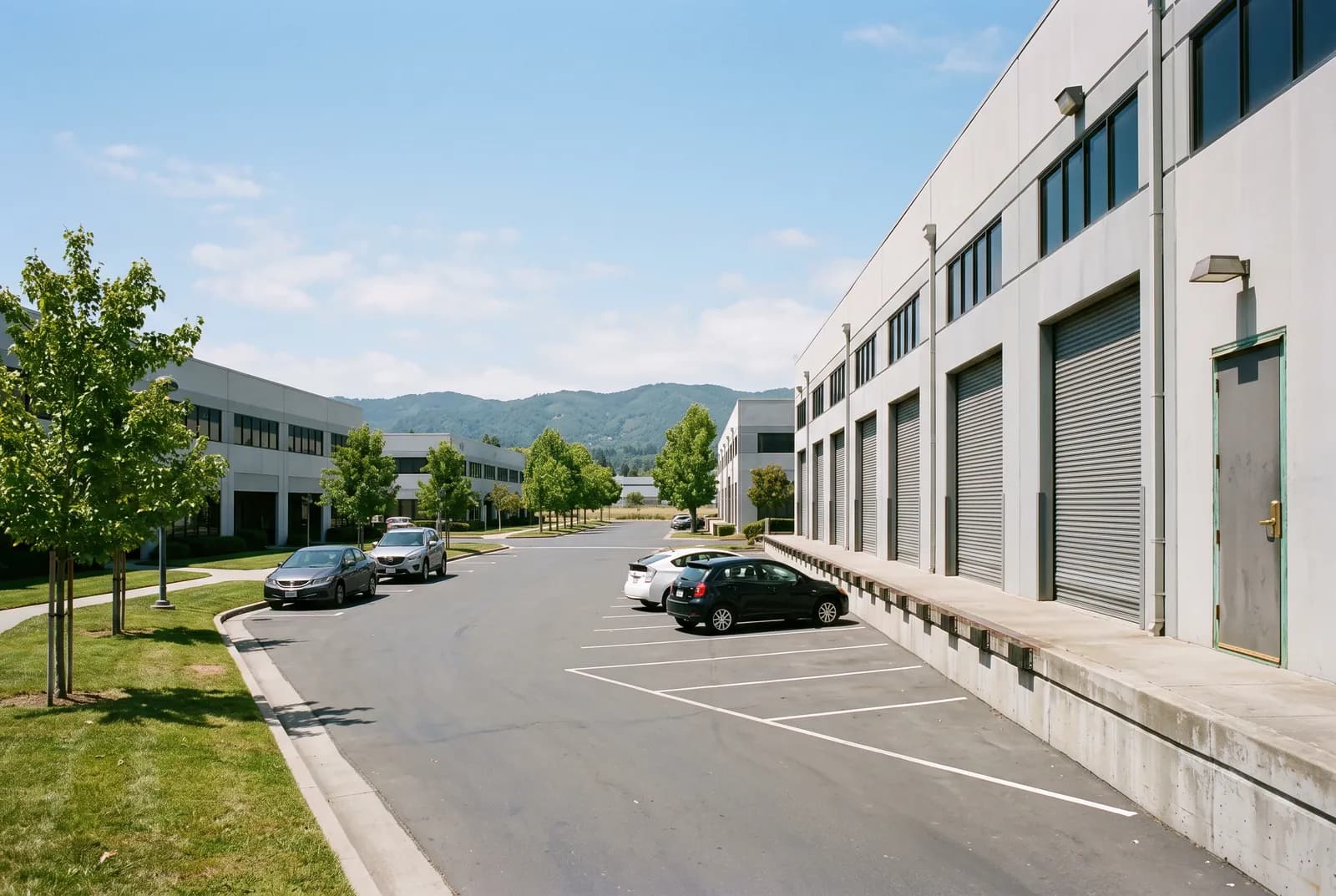
The commercial version of this city's argument is easier to see than the residential one. A front entrance out here reads a card, and behind that reader is a bar across the inside of the door that has to let people out whether anything is powered or not. The reader gets all the attention and the bar does all the work, and the bar is the part that wears. Latches drop out of adjustment, the dogging mechanism sticks in the open position after a busy summer, an end cap works loose, and the door starts standing unlatched without anyone noticing because the reader still lights up. Panic bars and exit devices are $322–$815 per door, and it is worth walking the building once a year rather than finding out at an inspection.
The boundary between our work and somebody else's is worth stating flatly, because it saves wasted call-outs out here. The mechanical half is ours: the exit device, the cylinder, the mortise case, the closer overhead, the strike, the keeper, the roll-up bay man door and the padlock on the yard gate. The credential list, the panel in the closet and the wiring behind the wall belong to whoever installed the system. Where a building wants readers added or reworked, access control is a custom quote and it stays that way on purpose. A frame that has been hit by a pallet jack, a door that was rehung by the last tenant and a jamb with three sets of abandoned holes in it all change the work, and none of that reaches us down a phone line. Somebody looks, then there is a number.
Behind the front entrance most of these buildings run on keys after all. The warehouse office, the tool crib, the electrical room, the roof hatch, the man door beside the roll-up bay and the gate onto the yard are ordinary cylinders, and in a building that has had three tenants they are usually three unrelated keyways on one ring. A master key system sorts that out so a shift lead opens what a shift lead should open and nothing beyond it. It is a custom quote, and the quote arrives with a chart you can read down the left-hand column, room by room, before anybody cuts a key. A business lockout, meanwhile, is $148–$272, and out here it is most often a Saturday delivery standing at a door that nobody on shift has a key to.
The parking fields produce the last category. Cars stand all day in lots big enough that the far row is a walk, and the calls are the usual ones: a key locked in with a laptop bag, a fob that has stopped being heard, a second key that never existed. A car lockout is $112–$208, a fob programmed on the spot is $98–$208, a key cut and coded from nothing is $163–$438, and ignition work is $194–$478. Say which building you are parked behind and roughly how far along the row, and wait at the vehicle rather than at the entrance. Twenty-six minutes is a real wait, and you get that number honestly rather than a friendlier one that would then be missed, with the evening $52 or the overnight $92 already inside the figure.
For a building, say which door it is: the glass front, a man door beside a roll-up bay, a rear door onto the yard, or an internal door in the back of house. Say whether the door has a bar across the inside of it and whether it currently latches on its own. For a car, give the row and the nearest building entrance plus the make, model, year and color.
Nearby
Over the hill, the same van
FAQ
Asked about North Bayshore
Our front door reads a card fine but it has stopped latching by itself.+
That is the exit device rather than the reader, and the two are unrelated even though they share a door. Latches fall out of adjustment, dogging mechanisms stick open, and a closer that has lost pressure leaves the door short of its keeper. All of that is mechanical and all of it is ours. Panic bars and exit devices are $322–$815 per door and the $89 service call is inside the number, not added afterward.
We want the back of house on one system so staff open some rooms and not others. Can that be priced over the phone?+
No, and any number you are given over the phone for that is invented. A master key chart is built out of what is actually hanging in each frame, and half of these buildings have two or three unrelated keyways left behind by earlier tenants. Somebody comes out, opens each door, lists what is in it, and writes the chart with you. Only then is there a figure, and it comes with the chart attached rather than on its own.
Can you add card readers to three more doors for us?+
The mechanical side of it, yes. Preparing three doors to take readers means cylinders, strikes, closers and frames, and that is our half of the job. The credential system itself, the panel and the wiring belong to whoever installed it, and we say so on the phone rather than after a call-out fee. Our part is a custom quote because three doors in a tilt-up building are rarely three of the same door.
Open 24 hours, 7 days
Say what the door reads, and the rest of the call is short
Mountain View and the mid-Peninsula, at any hour. A fob, a card, a code or a plain key, and how many doors stand between the sidewalk and you — that decides the work, and the work decides the number. The number comes back on the same call with the $89 call-out and the clock already inside it, and it is the number on the receipt. The labor carries 90 days, in writing.