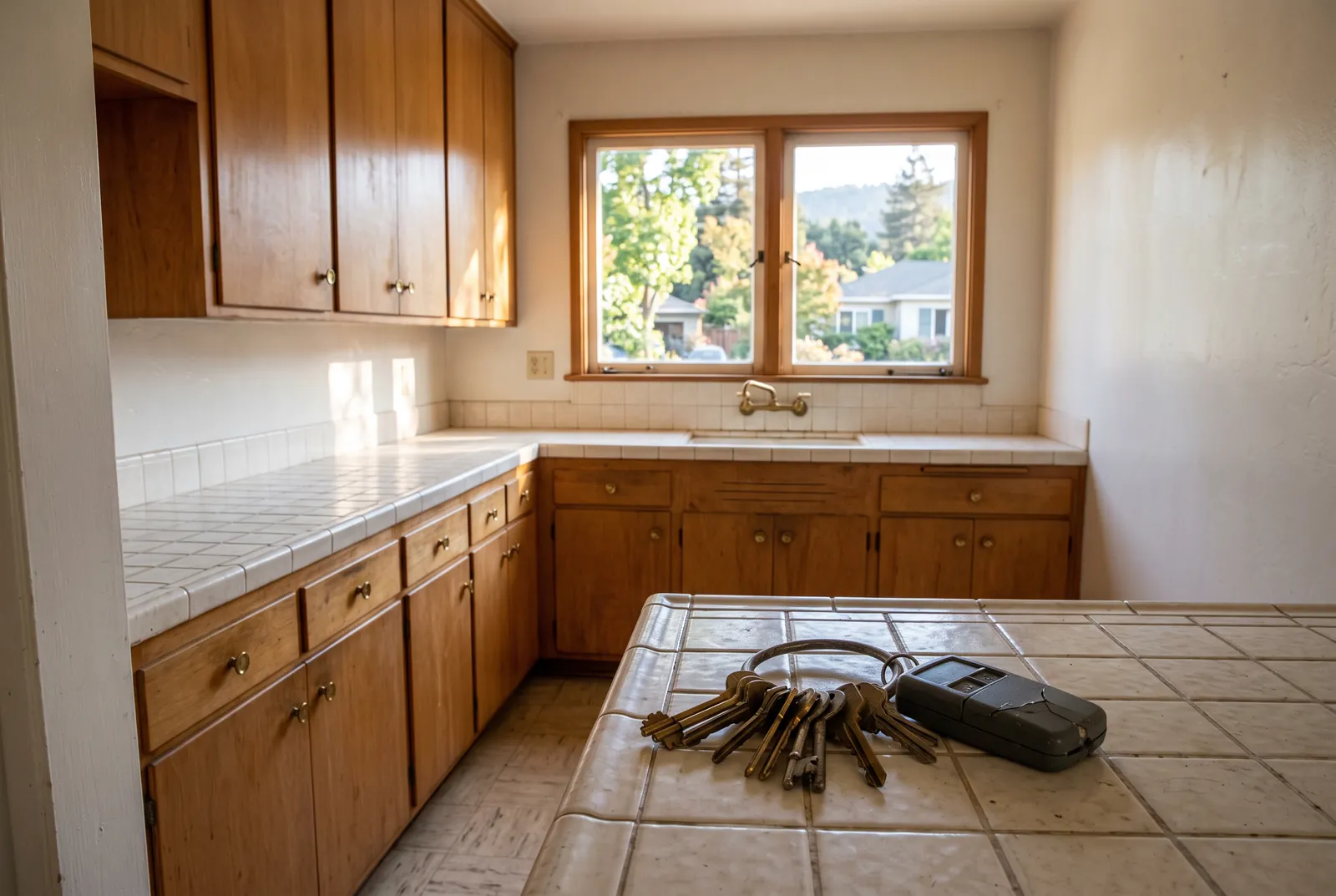
Eleven keys on an empty counter
The house is empty and the movers are not coming until Saturday. Afternoon sun is coming through an uncurtained window onto a bare wood floor and a tile counter. On the counter is what the sale produced: a ring with eleven keys on it, four brass and worn smooth, two with plastic caps in different colors, one flat one with a hole punched in the wrong end, and four that nobody in the transaction could identify. Next to the ring, a garage remote with a cracked case.
This is the ordinary handover on the old streets. Old Mountain View, Sylvan Park, Cuesta Park, the flat blocks over toward Rex Manor: houses from the thirties through the fifties, one door between the sidewalk and the kitchen, ordinary cylinders, and hardware that has accumulated one lock at a time over seventy years. Nobody chose that ring. It assembled itself.
None of it is alarming and none of it is urgent in the way people imagine. It is bookkeeping. The first month is when the bookkeeping is easy, because the house is empty, every door is clear, and nothing has to be moved to get at anything.
Week one, the free half hour
Start with everything that costs nothing. If there is a keypad on the front door, change the code, because a code set by a previous owner has been shared with more people than anyone remembers. Same for any keypad on the door frame beside the garage. Same for a gate at the side of the house.
Then clear the garage opener. Nearly every motor head made in the last thirty years has a learn button on it: hold it down until the indicator goes out, and every remote the unit has ever been taught is forgotten. Re-pair your own remotes afterward. That takes about two minutes and deals with the remote that went away in a car the sellers sold, which no amount of work on the locks will ever reach. It is the single largest opening in the property and the cheapest thing on this page to secure.
While you are at each keypad, answer one question: does it have a keyway, and is there a cut key for it. On a house that has just changed hands the honest answer is usually no idea, and that is fine as long as it gets fixed on a visit you are having anyway. A dead keypad on a Tuesday evening is a $138 to $252 call. A key cut in daylight is a fraction of that.
Week one, count cylinders rather than doors
Walk the house with a notepad. A front door with a keyed knob and a deadbolt above it is two cylinders on one door, and that catches people out on the phone. A typical house on these streets comes to five: front knob, front deadbolt, back door, the side door of the garage, and a gate or a shed padlock. Six with a mailbox at the curb that nobody has opened in a decade.
Note the shape of each keyhole and whether the keys look like each other. Cylinders from different decades take differently shaped blanks, and a key from one family will not enter a lock from another no matter what is done to the pins. Where the house has a mixture, one cylinder gets swapped for a matching one so that everything can run on a single key, and that swap is the usual reason a job lands at the upper end of a range instead of the lower.
Then one visit. Rekeying is $32 to $50 per cylinder, the second and third at the low end because the van is already at the curb, and the $89 service call counted once for the stop rather than once per lock. When it is finished, every key handed out during the sale is scrap metal. This is the most useful thing done in the first month and also the cheapest.
Week two, the door before anything gets bought
Two tests, both free, both done in about a minute. Open an exterior door wide so it hangs in the air and throw the deadbolt with the thumb turn. Then close the door and do it again. If the bolt runs out smoothly in the air and has to be forced with the door shut, the leaf has settled on its hinges and the bolt is catching the edge of its hole instead of the middle. On a house of this age that is the normal finding rather than the exception.
Second test: take one screw out of the strike plate on the frame and look at it. Three-quarters of an inch means the plate is fastened to a strip of trim and nothing more. Long screws that pass through the frame and bite into the stud behind it, on the strike and on the top hinge, change what that door will withstand more than any lock will, they take a few minutes, and they are part of a visit rather than a purchase.
This is the step that gets skipped, and skipping it is what makes the next step disappointing. Households on these streets adapt to a door that has moved without ever noticing they are doing it: a lift on the handle, a shoulder against the stile, a pull toward you before the key will turn. Ask someone how they lock their own front door and you get a small piece of choreography for an answer.
Weeks three and four, what is worth buying and in what order
First, a deadbolt on any exterior door that has only a latch. The door between the garage and the kitchen is usually the one, and it is worth thinking about, since it sits behind a large door that opens from the street with a remote. Fitted, with the frame work underneath it, that is $133 to $345.
Second, a spare key that has actually been tried in the door and lives somewhere that is not a hiding place. A neighbor on the same block is the best answer in a city where households keep different hours. A decent lock box, out of sight and screwed to something solid, is next. Under the mat, over the frame and inside the fake rock are the three places anyone checks first, in that order.
Third, and only now, a keypad if you want one, at $205 to $505. It belongs on the door the household actually uses rather than the one facing the street, and it goes on after week two rather than before, because a small gearmotor cannot pull a settled door into line the way a shoulder can. A keypad that eats a set of cells every two months nearly always has a frame problem underneath it rather than a fault in the lock.
What these streets have that the new blocks do not
One door, one key, one decision. There is no list of credentials held by someone else, no controller in a closet, no on-call number to reach before anything can be touched, and no question about who is entitled to order the work. You own the door. That sounds obvious until you have spent an evening on the other side of town waiting for a property manager to call back.
It also means the whole first-month list is genuinely one stop. Five cylinders, a deadbolt where there is only a latch, long screws in two frames and a key cut for the keypad: under two hours in an empty house, with the $89 counted once. Drive time from the base near Castro Street is 12 minutes to Old Mountain View, 16 to Sylvan Park, 18 to Cuesta Park, 20 to Rex Manor.
Do it in the week you close rather than the week you move in. The keys that matter are the ones that were handed around before there was any furniture in the house, and an empty house is the fastest visit anybody will ever have. Ninety days on the labor, printed on the receipt.
Quick answers
Do I need new locks after buying, or is rekeying enough?+
Rekeying is enough unless a lock has actually failed. New pins retire every key handed out during the sale at $32 to $50 a cylinder, against $133 to $345 for hardware you did not need. Anyone quoting new locks purely to give you a new key is selling hardware rather than answering the question.
Can every door in the house go on one key?+
Usually, yes. The limit is the shape of the keyway: cylinders from different families take differently shaped blanks and no repinning bridges that. Where the house has a mixture, one cylinder is swapped for a matching one, which is a small part and a few minutes, and it is what moves a job to the top of the range.
How long does the whole first-month list take?+
Under two hours in an empty house for five cylinders, a deadbolt where there is only a latch and frame work on two doors. Most of the list is free anyway: the codes, the garage opener memory, and the two tests on the door. The $89 visit is counted once for the stop.
Need it handled rather than read about?
(650) 405-1526More guides