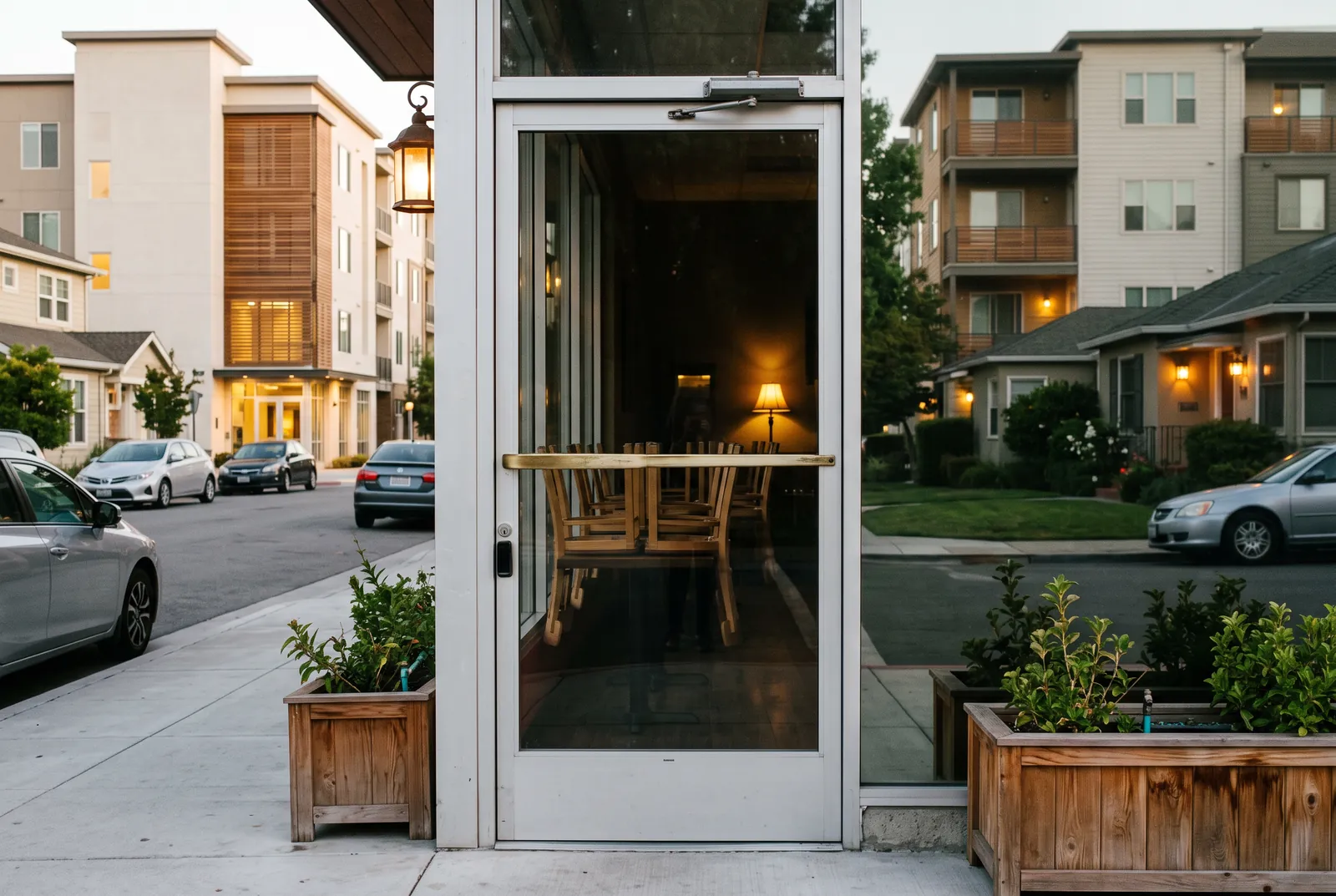
Ten past nine, chairs on the tables
The shop is narrow, one bay wide, with a room upstairs and an office window above the awning. The door is a single leaf of glass in an aluminum frame, and there is a brass push bar across the inside of it that has gone pale in one spot the width of a hand. Overhead an arm runs from the top of the leaf to a small box on the frame. Inside, chairs are up on the tables and one light is still on at the back.
The owner is on the sidewalk with a ring of keys, pushing the door to make sure it caught. That push is the most informative thing on this page. Doors that need it have already told you what is wrong with them.
Castro Street is twelve minutes from the base and it is where a fair share of this work is. Shops at street level, offices and studios on the second floor over them, back doors onto a service alley, and hardware that has been added to one piece at a time since long before anyone thought about it as a system.
What the door is actually made of
An aluminum storefront door is a frame of extruded tube holding a sheet of glass, and its whole character comes from how much metal there is at the edges. A narrow stile door has about two inches of aluminum down the lock side. A medium stile has around three and a half, a wide stile five. That number decides what can be fitted into the leaf, and it is the first thing measured on any quote.
The leaf hangs one of two ways. On butt hinges down the lock-side jamb, like a house door, or on a pivot at the top and a pivot in the threshold, which is the older and stronger arrangement and the one that quietly wears out. A pivot that has worn lets the leaf drop at its outer corner, and a door that has dropped a sixteenth of an inch stops meeting its strike squarely.
The threshold matters too, more than anyone expects. The bottom rail sweeps a strip of aluminum that has taken every shoe and every hand truck for twenty years. Where that strip is worn hollow, weather comes under the door and the bottom pivot sits in it.
The lock is a latch, not a deadbolt
The main lock on a storefront leaf is usually a deadlatch: a beveled latch bolt with a small plunger beside it that rides against the strike and stops the latch from being pushed back once the door is closed. The cylinder in the face turns a cam, the cam retracts the latch, and that is the whole mechanism. It is designed for a door that gets opened four hundred times a day, which a deadbolt is not.
It fails in ways that are easy to read. The plunger stops sitting on the strike because the leaf dropped, and then the latch can be pushed. The latch tip wears round and stops holding. The cam wears at the corner where it drives the latch, so the key turns further than it used to before anything happens. Cylinder work on a leaf like this is $168 to $495 depending on what has to come out and go back.
Double doors add a piece. Where two leaves meet with no post between them, the lock is often a hook bolt that swings out and grabs the other leaf, or there is a removable mullion that stands between them and takes the strike. A mullion that has been taken out for a delivery and put back a quarter inch off center is a genuinely common finding, and it makes a good lock behave like a bad one.
The arm overhead costs more than anyone thinks
The closer is the piece nobody budgets for and the piece that decides how long everything else lasts. It has two speeds inside it, adjustable with small screws under the cover: a sweep that carries the door most of the way, and a latch speed for the last few inches that gives it the push to seat properly. When the latch speed is set too slow, the leaf drifts up to its strike and stops, and the door looks shut and is not.
When it is set too fast, the opposite: every close is a slam, and a hundred slams a day work the strike screws loose, chip the latch tip and eventually crack the plate the closer is bolted to. A shop door that has to be pushed at closing time is running one of those two problems, and the owner has adapted to it rather than fixed it.
The cost of not adjusting it lands on the lock. A latch driven into a strike it does not quite meet takes the whole force of the closer at an angle it was not designed for, and it wears in months instead of years. On a call about a lock that keeps failing, the closer is checked before anything gets quoted, because replacing a latch on a door that will just eat the next one is not work worth charging for.
What the door is asked to do, in order of importance
Let people out, always, instantly, with one motion and no thought. That is the push bar, and where the room holds enough people it is required rather than optional. A bar that binds, a bar with a dogging screw someone left engaged overnight, a bar whose latch no longer retracts fully: those are the faults that matter most and get looked at first. Exit devices are $322 to $815, and the spread is mostly whether the frame and strike also have to be put right.
Let staff in at seven in the morning without a struggle, and let deliveries in at the back without the front being open. That is usually where a shop ends up with more keys than people, one for the front, one for the alley door, one for the roll-down, one for the office above. A single key that opens what a person is supposed to open and nothing else is a master key system, and that is quoted after a look rather than off a list, because it depends entirely on what is already on the doors.
Hold shut overnight, and hold shut in a way that does not depend on somebody remembering to push. That is the closer and the strike, together, and it is a maintenance question rather than a purchase. Where a door has been forced at some point and the frame carries the marks, the repair is $178 to $465 and is priced after seeing what is bent.
The office above, and the key that opens both
The upstairs on Castro Street is its own small problem. A separate street door beside the shop front, a flight of stairs, and one or two suite doors at the top, all fitted at different times by different tenants. It is the classic place to find four locks that a single person needs and four keys they have to sort through in the dark.
Where a shop and the office above share an owner, putting them on a properly planned set of keys is the highest value work on the whole building, and it is also the work most often done badly. A key that has been cut to open two locks by accident, because both happened to accept the same blank and the cuts were close enough, is not a master key system. It is a coincidence, and it fails.
Where readers and fobs are wanted instead, for staff turnover or for a shared stairwell, that is access control and it is quoted after a survey. The mechanical side of it is the part to insist on: whatever goes on the door, keep a cylinder in it and keep a key cut for that cylinder somewhere a person can reach at seven in the morning.
What it costs when the door is shut and you are outside it
A business lockout is $148 to $272, with the $89 service call already inside the figure. Between 8pm and midnight it carries $52 and between midnight and 7am it carries $92, said on the phone before anyone sets off, so the number quoted is the number on the receipt. Old Mountain View is about 12 minutes from the base. Ninety days on the labor.
The hardware figures worth knowing in advance: storefront door locks $168 to $495, exit devices $322 to $815, repair after a door has been forced $178 to $465, and rekeying an existing cylinder $32 to $50. Master key systems and access control are quoted after a look, because on a street of buildings this old there is no honest way to price them from a description over the phone.
One habit worth more than any of it. Once a month, at closing, stand outside and pull the door toward you without a key in it. If it comes toward you at all, something in the sequence of leaf, closer, latch and strike has moved. That is a Tuesday afternoon repair if it is caught then, and something else entirely if it is not.
Quick answers
My shop door has to be pushed to catch. Is that the lock?+
Usually the closer or the alignment rather than the lock. The last few inches of the swing are controlled by a separate speed adjustment, and when it is set too slow the leaf drifts up to the strike without the force to seat. Both are checked before any hardware is quoted.
Can one key open the shop, the alley door and the office upstairs?+
Usually yes, and it is worth planning rather than improvising. It is a master key system, quoted after a look because it depends on what cylinders are already on those doors and whether they take the same blank. A key that happens to open two locks by chance is not a system and it will fail.
How fast can someone get to Castro Street after hours?+
About 12 minutes to Old Mountain View from the base, against roughly 18 as the average across the city. A business lockout is $148 to $272 with the $89 call inside the figure, plus $52 between 8pm and midnight or $92 between midnight and 7am.
Need it handled rather than read about?
(650) 405-1526More guides