Master Key Systems in Mountain View
Priced after the doors are walked and counted. One key sitting above a key for every door, for an owner with a strip on Castro Street or a manager holding a corridor of suites, a mail lobby and a utility room.
4.9 / 5· 198 reviews from Mountain View and the mid-Peninsula
custom quote
Typical price
18 min
Avg. arrival
24/7
Availability
A master key system is a hierarchy held in metal. Each tenant, each department or each crew opens their own door and nothing beyond it. A master opens a floor, a row of suites or a whole property. Sometimes a grand master sits above that for an owner or a manager. Drawn properly, it replaces a drawer of keys with one worth protecting. Drawn carelessly, it produces keys that open doors nobody intended, which is worse than having no system.
Which is why nothing here is quoted over the phone. Every opening is walked and counted first: what hardware hangs in it, whether the cylinders can carry the pinning, who needs to reach it, and which doors must stay outside the system entirely. There is always at least one of those and usually more than an owner expects. A server room. A records cabinet. A supply closet with controlled stock in it.
In this city the work sits mostly in the newer blocks and in the offices and warehouses out by the bay, and it is the half of those buildings nobody has counted. The doors residents and staff use every day read a credential and are administered from a desk. Behind that runs a mechanical layer that never got organized: electrical and telecom rooms, riser and stair doors, the trash room, the janitorial closets, the roof hatch, the mail hall, the pedestrian gate beside the garage door. That layer is usually a ring of keys with faded labels in a drawer, and it is exactly what a master key system is for. The other recurring shape is an owner holding several rental houses on the older streets, where one restricted keyway across the portfolio does more work than anything else on this page.
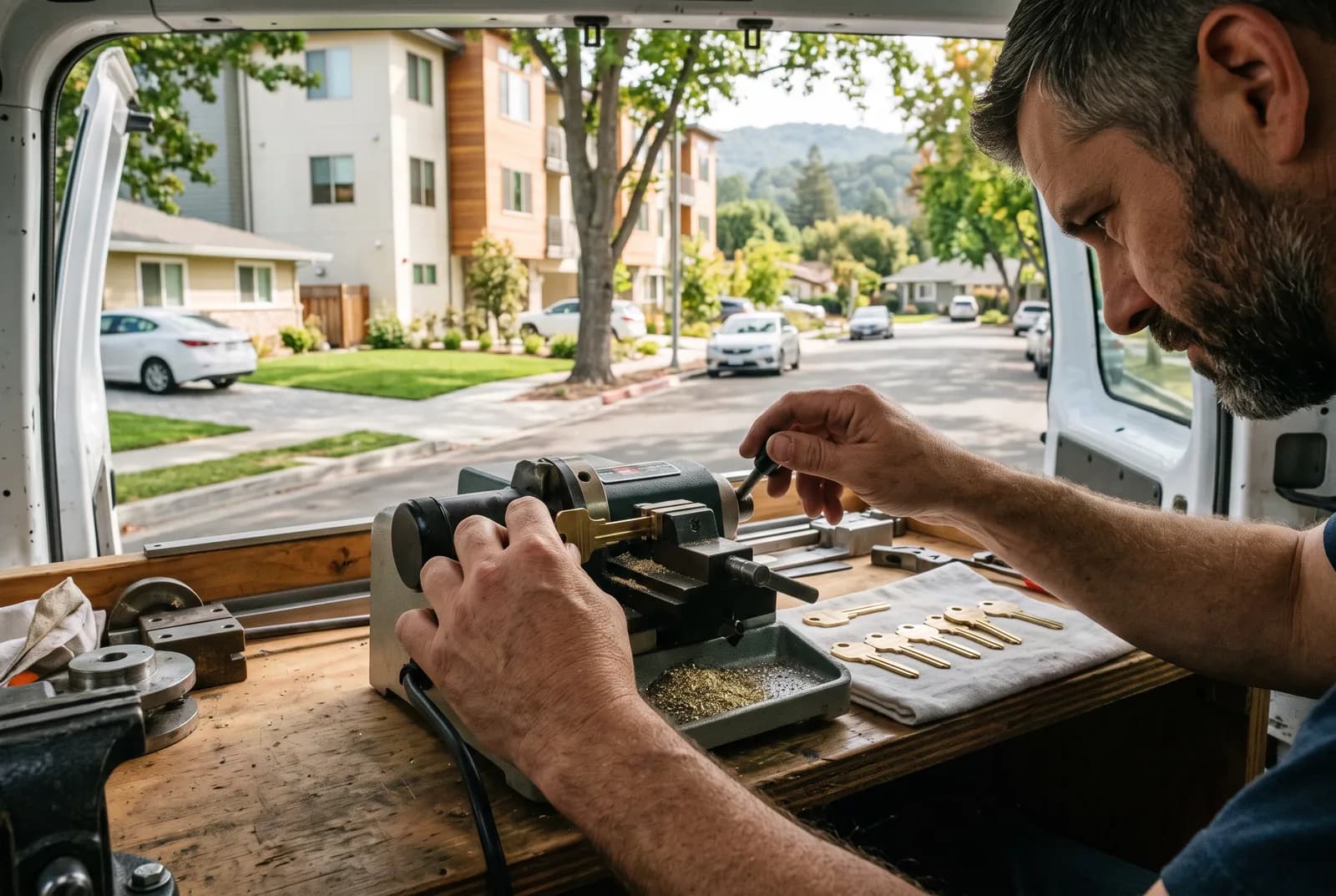
The drawing is the job and the pinning is the afternoon. After the walk, the levels are sketched on paper, a restricted keyway goes underneath so no key can be copied at a kiosk, and each cylinder is pinned on the van bench with master pins stacked above change pins, then tried in its own door with both keys. Sound existing cylinders are repinned into the system rather than thrown away, which is usually the largest saving available. Keys are stamped by level and signed for against a log. You are left holding a chart that lists every door against every key that opens it, with blank rows for the doors you add next year.
Cost is one itemized figure after the walk, because door count, key levels, keyway choice and the state of each cylinder move the number too far for a published range. The $89 visit is the survey and it counts toward the job. An approved quote holds. A single door repinned later, when somebody leaves, is $32 to $50 and stays inside the system. Ninety days on the workmanship.
“I hold a strip of four units on Castro with a mail lobby and a utility room behind them, and I was carrying eleven keys. The locksmith walked every door with me, counted them, drew the chart and gave the figure after that, not before. Now one key opens what I need and each tenant opens only their own. Another company quoted me a number over the phone without ever seeing the doors, which told me what I needed to know.”
All sixteen jobs are printed here, fourteen with ranges and two quoted once the doors have been counted on site. What moves a figure inside its range is which door it is and how it opens. One cylinder on a house in the old part of town takes the low end. A door that reads a credential, with a mechanical cylinder under the panel that has not been turned in years, takes the time that cylinder has been owed. Say which door stopped you and the range closes to one figure.
- Daytime (7am–8pm)standard rates
- Evening (8pm–12am)+$52
- Overnight (12am–7am)+$92
FAQ
Master Key Systems: quick answers
Our building runs on fobs. Why would we need keys at all?+
Because the readers are on the doors people use, and the building has a second set of doors that no reader ever went on: risers, telecom and electrical rooms, the roof hatch, the trash room, the janitorial closets, the gate beside the garage door. Those are metal and they are usually the least organized part of the property. A system puts them under one chart, with a master that opens them and change keys that do not.
Why can nobody price this on the phone?+
Door count, the number of key levels and the state of each cylinder are what set the price, and a description over the phone gives none of the three. A number quoted without the walk is a guess, and the correction turns up halfway through the installation.
A manager moved on and the building master went with them.+
Read the chart and you know precisely which doors that key opened, so the repinning stops at those cylinders. The change keys and sub-masters below them stay as they are. A restricted keyway means no counter ever cut a copy of it, so what is out there is one key rather than an unknown number. The count of doors on the chart sets the figure, and you hear it before anyone starts.
Related
More commercial services
Open 24 hours, 7 days
Say what the door reads, and the rest of the call is short
Mountain View and the mid-Peninsula, at any hour. A fob, a card, a code or a plain key, and how many doors stand between the sidewalk and you — that decides the work, and the work decides the number. The number comes back on the same call with the $89 call-out and the clock already inside it, and it is the number on the receipt. The labor carries 90 days, in writing.